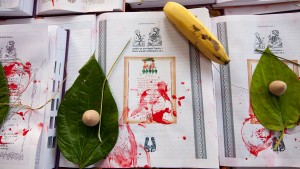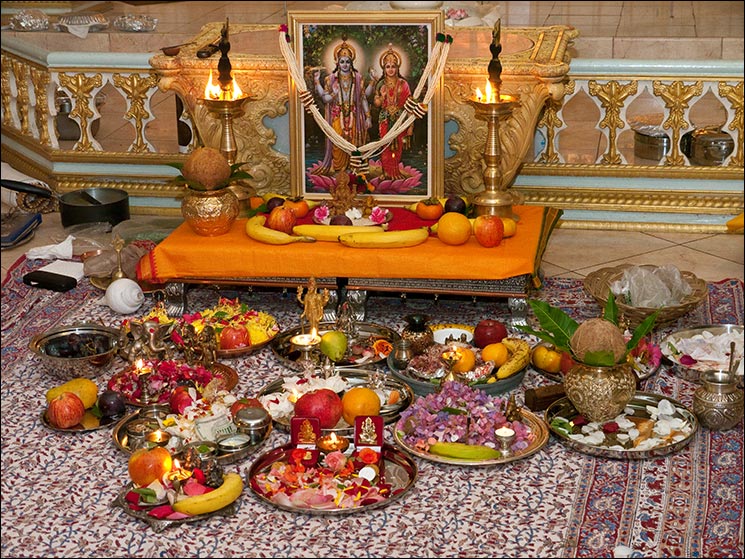
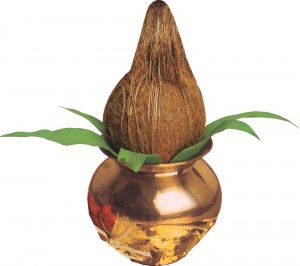
A puja is a religious ceremony performed in temples or in homes that involves worship through the use of a sacred image. At its most basic level of understanding, puja is a symbolic means of communication, a way to reach out to higher powers. There are many ways that we can reach out to divinity: through prayer, meditation, acts of charity, and so forth, but one of the most import and common means is through ritual. In fact, ritual is the foundation of worship and all religions employ rituals as a means to contact the Divine. The Christian Eucharist, the Jewish Seder (passover meal), the Islamic practice of bowing towards Mecca, the Buddhist use of the prayer-wheel and, of course, the Hindu puja are all important uses of ritual that allows a worshipper to communicate with higher powers. The word puja derives from the Sanskrit root puj, to honor or respect.A puja can be short or long, lasting minutes or days, simple or elaborate, involving just the worshipper or many priests and guests, but in every case puja involves the invocation of a Deity as “a guest” in the home, temple or heart of the worshiper. A puja usually employs some kind of sacred image or photo, which serves as a focal point wherein the “spirit” of the Deity is invited to reside for the duration of the ceremony. The sacred image or photo serves as a kind of “receptacle” to house the spirit of the Deity. The image is usually made of metal, wood or, now a days even plastic, but it could even be just a sketch of a Deity drawn on the ground in sand or earth. One can think of the sacred image as an icon that becomes “switch on” or “surcharged” with the spirit of the Deity during the time of puja. Sometimes, instead of using a specific sacred image or photo, just a coconut with leaves in a copper pot is used as a “generic” receptacle. Any God or Goddess can then be invited into this receptacle for the ritual. Puja can be viewed as either the Deity coming down to man and appearing in a form comprehensible to human beings, or man creating a symbolic form of the Deity that is then used to reach out towards the Deity. In other words, puja can be either a descending process or an ascending process. This is a matter of theology and faith.
 Once a particular Deity was been evoked, puja is simply the receiving and adoration of that God or Goddess as a guest. The Deity is then worshiped in a logical and loving manner as one would treat a human guest. A formal puja usually involves 16 separate offerings made to the Deity, but could also involve as many as 27 items of worship or as few as just a couple of items. These items include welcoming and seating of the Deity; washing the feet, hands and mouth; bathing, dressing, ornamentation of the Deity; feeding and worship with incense, lamps and prayers and finally, sending back or releasing the Deity from the receptacle. In its more simple form, puja may only include incense and a lamp. The process is totally malleable and can easily be adjusted to suit the conditions of the worshipper.
Pujas are performed both in temples (mandirs) and in private homes. In temples, they are usually associated with the daily worship of the temple’s sacred images and are performed only by priests. They are also performed on special festival days or upon request of individuals by temple priests. In homes, pujas are performed for special occasions such as anniversaries, graduations, the birth of children, memorial days, or simply for general prosperity and peace within the family. In this case, the family members themselves perform the puja under the guidance of a priest. Commonly performed pujas include Ganesha, Satya Narayana, Durga, and Lakshmi pujas. In fact, a puja can be performed for any God or Goddess or even a combination of Deities. Perhaps the most important part of a puja is the final blessing by the priest and the distribution of prasada at the end. The purpose of a puja is to evoke the presence of a Deity and then to receive the blessing of that Deity. One of the jobs of the priest is to give these blessings. Prasada is the blessed food that has been offered to the Deity during the puja. This food is then offered to all those who have attended the puja. Prasada is the blessing of the Deity.
Hinduism is full of many sacred rituals and colorful ceremonies. These include weddings, the naming of children, hair cutting ceremonies and funerals. Collectively, these ceremonies are called samskaras, rites of passage. Pujas always form the basis of Hindu samskaras and during the course of a marriage, for example, many small pujas will be performed. There may be a dozen pujas contained within the one large marriage ceremony and these pujas involve the invocation of various Gods and Goddess to bless the couple and even the worship of ancestors, pitri-puja, to give blessings to the couple.
Archana
Apart from being a common girl’s name, archana is akin to puja. Technically, archana and puja are the same thing and the words could be interchanged, however, in practice puja generally refers to a more formal “sit down” ceremony, while archana is a ceremony performed by a temple priest on a “walk-in basis.” Typically, a devotee will come to a temple with a basket of fruits and flowers and perhaps a coconut and the priest will offer these items to the Deity on the altar along with a lamp and prayers. The devotee will then receive the food offerings back as a prasada or blessings from the Deity. This is archana.
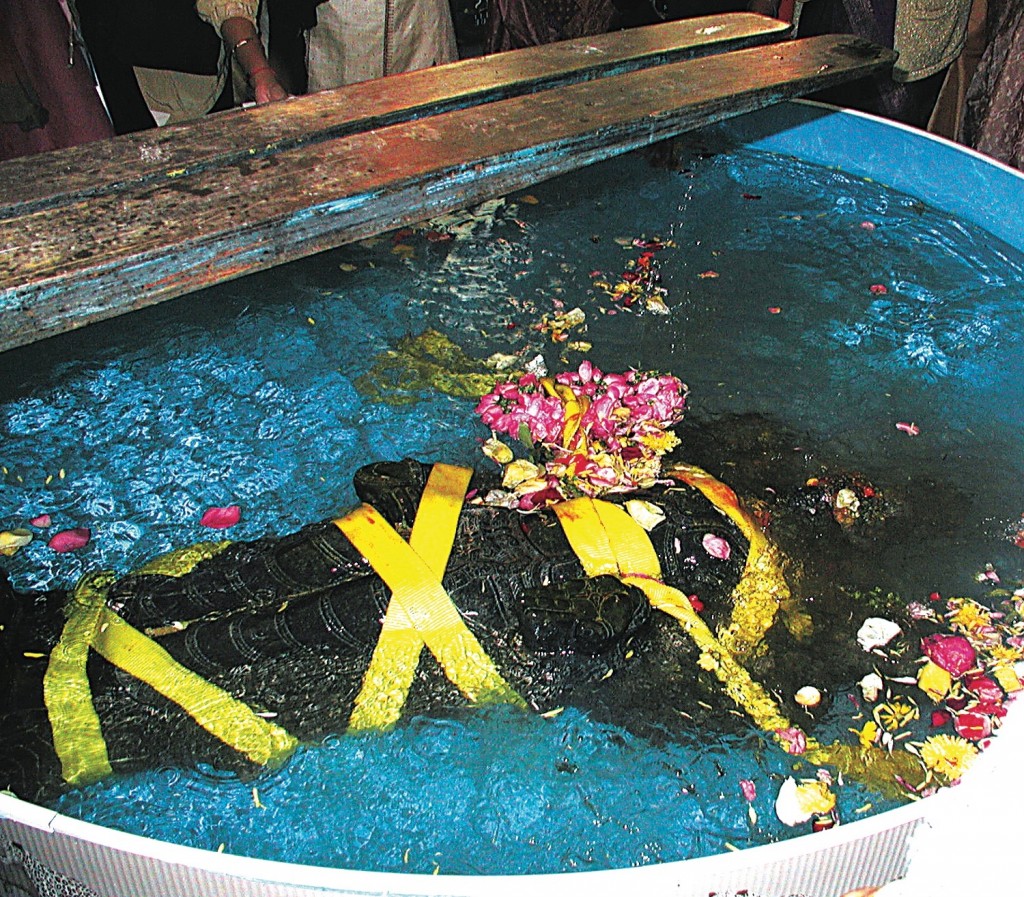
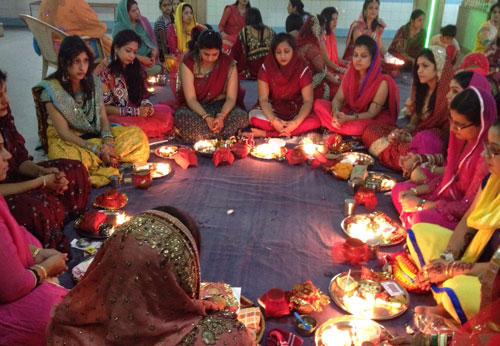 Karwa Chauth is a “ladies” festival that is especially popular within many of the communities from north India, particularly the Punjabi community. It is a vow to fast undertaken by married ladies, who offer prayers to the Goddess Gauri seeking the welfare, prosperity, and longevity of their husbands and families. The word, “karwa” refers to an earthen pot with a spout, which is seen as a domestic symbol for peace and prosperity. The word “chauth,” means 4th and it refers to the fourth lunar day after the new moon in the month of Karttika (October-November) when the vow is followed.
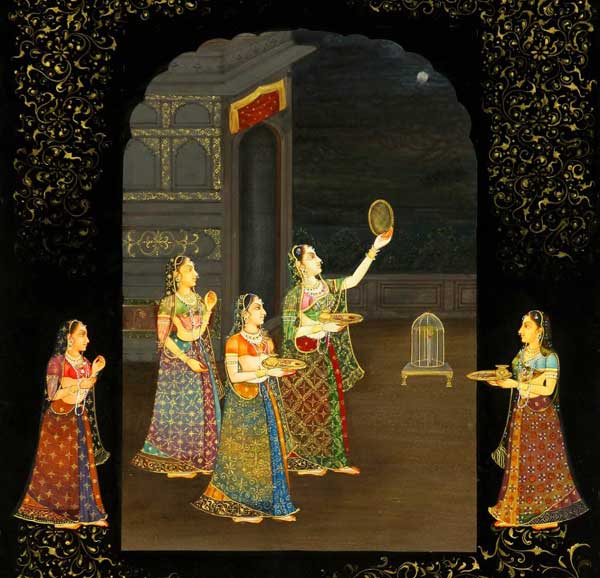 For the rest of the day they will abstain from food including even water. In the later afternoon, a few hours before moonrise, they will dress in their best outfits and jewelry, which may include their wedding outfits, and then get together at a temple or someone’s home for a collective puja. Typically the ladies will sit in a circle and perform a Gauri puja accompanied by a traditional story that describes the origins and benefits of following this fast. During the puja each lady holds a tray that is passed around the circle at different times making a total of seven rounds. These seven rounds match the seven circles that a bride and groom take around the sacred fire during their wedding ceremony. Once the puja is completed the ladies will go outside and wait for the moon to rise. They do not break their fast until they have seen the moon. Interestingly, they never look directly at the moon, but only through a screen like a sieve or at a reflection of the moon in water. After seeing the moon each lady will return home, bow to her husband for a blessing and then eat a simple vegetarian meal. That at least is the tradition.
 After all the discussion about the Hindu calendar being a lunar calendar, makara sankranti is one of the few major festivals that does not follow the lunar calendar. Instead it is celebrated according to the solar calendar and therefore always falls on the same day in the western calendar, January 14th. Most other Hindu festivals follow the lunar calendar and therefore will vary by approximately three weeks from year to year against the solar calendar. Makara Sankranti is the celebration of the sun beginning its path on the
 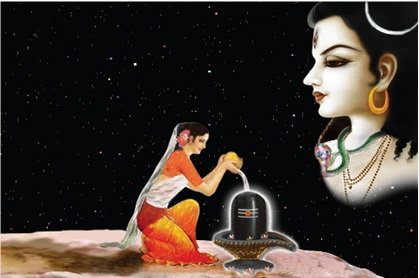 Literally, the “Great Night of Shiva” is celebrated every year on the 13th or sometimes the 14th lunar night (
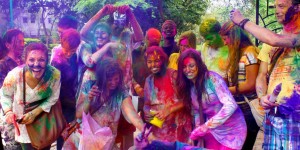 Also known as the Festival of Colors or even the Mardi Gras of Hinduism, Holi traditionally takes place over two days in late February or early March on the full moon day of the month of Phalgun. Holi is a popular spring festival observed particularly in North India that includes a bonfire and the throwing of colored powders. On the first day there is a bonfire which represents the burning the demoness, Holika.
 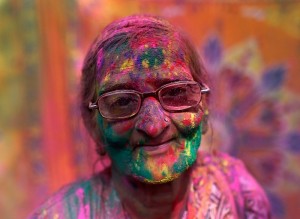 It is the triumph of good over evil. On the second day colored powders, red, blue, yellow, green, white, are exchanged between the participants along with hugs and smiles. In the west the two days are usually merged into one afternoon or evening. It is a joyous festival as you can see from the photo.
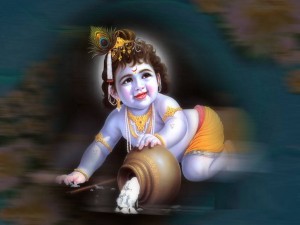 Krishna Janmashtami is observed on the eighth lunar day of the dark half of (krishna paksha) the month of Shraavan when the
 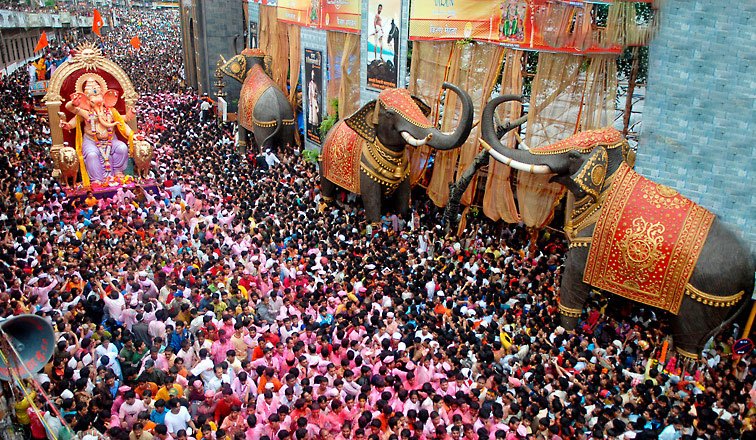 Ganesh Chaturthi is the festival day when Ganesha, the son of Shiva and Parvati, first appeared for all his devotees. The day is also known as Vinayaka Chaturthi and it is observed in the month of Bhadrapada starting on the fourth lunar day (chathurthi) of the waxing moon.
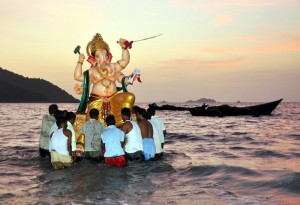 This always comes between late August and early September. Traditionally the festival lasts for 10 days, but in most Hindu temples in the West, the festival is generally celebrated for just one day. Ganesha is widely worshipped as the supreme Deity of wisdom, prosperity and good fortune. Most Hindus will begin any puja or important event with the invocation of Ganesha.
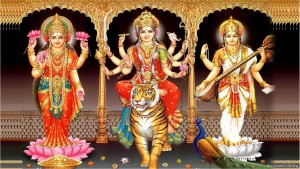 The nine nights are divided into three sets of three nights each to adore three different aspects of the Goddess. On the first three nights the Goddess Durga is invoked as a spiritual force to destroy all impurities, vices and defects. On the second set of three nights the Goddess Lakshmi is adored as the giver of spiritual wealth. The final set of three nights is spent in worship of the Goddess Sarasvati, who is the embodiment of wisdom. In order to have full success in life, believers seek the blessings of all three aspects of the Goddess, who first destroys impurities from the heart, then endows the worshipper with spiritual powers, and finally gives the maturity of wisdom to know how to employ these great powers. Hence the nine nights of worship. Most common of all is the traditional Ras Garba dances that are performed during these Nava Ratris, This dance is traditionally a Gujarati custom, but it is quickly becoming the main focus of the Nava Ratri celebrations in the West.
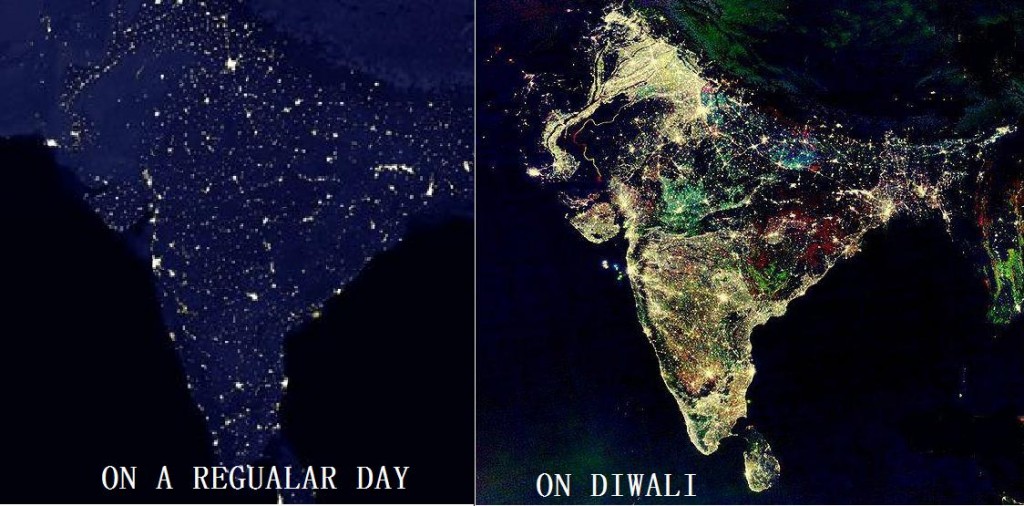 In Sanskrit Diwali is written as dipavali, “dipa” is a lamp and “avali” means a row. So dipavali is literally a row of lamps. Today in many Western countries Diwali has become famous as The Festival of Lights. Similar to Christmas in terms of lights, Hindus will string lights around their houses and temples. Diwali is always celebrated on the new moon night at the end of the month of Aashwini. There are numerous interpretations regarding the origins of this famous festival, but the one I prefer connects to the Nava Ratri and Vijaya Dashami festivals. After killing Ravan on the 10th lunar day (Vijaya Dashami), Rama returns to Ayodhya, his capital, on the following new moon (amavashya) night. Diwali comes exactly twenty days after Vijaya Dashami. Since there is no moon on that day, the residents of Ayodhya are said to have illuminated the city by placing lamps on their homes and other building eager for Rama’s return. Hence the name Diwali. Other interpretations have to do with Krishna defeating the demon Narakasura, or in honor of the day Bali went to rule the nether-world according to the order of Vishnu. In all cases Diwali is the celebration of good conquering evil and the bringing of light back into the world. On the day of Diwali, many devotees wear new clothes, share sweets and snacks, and light firecrackers. Some North Indian business communities start their financial year on Diwali and so open their new business books on this day.
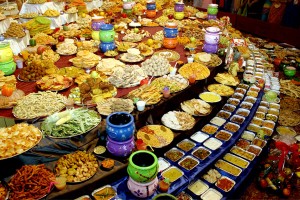 Annakuta generally takes place the day following Diwali. “Anna” means food and kutameans a “mound,” so literally Annakuta is a “mound of food.” The festival is celebrated in temples as members bring food offerings that are added to a growing number of dishes used to decorate an altar. Sometimes the festival is connected to another festival called Govardhana Puja, which celebrates the day Shri Krishna lifted the mountain known as Govardhana. In this case the great “mound of food” becomes Govardhana mountain. Usually the festival includes a Krishna puja, bhajanas, a telling of the story of Krishan lifting Govardhan mountain and arati.