Why no shoes in a Temple
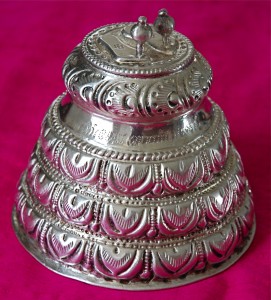
Feet hold powerful symbolism within Hindu culture. You take off your shoes when you enter a temple. Sitting in a temple you never point your feet towards the altar or other worshippers, especially seniors. The feet of people are considered low. In fact, one of the greatest insults you can make is to throw shoes at someone. And yet the feet of God are special. God’s feet are often called “lotus feet” and in some temples even a small set of symbolic shoes representing the feet of the Deity is touched to the head of worshippers as a blessing. This blessing implement is called a shathari. Worshippers even drink the feet-bathing water of God as a prasada. This is called charanamrita or charnam for short.
The basis for feet symbolism goes back to the Vedic conception of the universe as the body of God. Just like a body has high and low parts so this universe has high and low, pure and impure places. Up is high, down is low. Feet touch the ground, which is low, and so when you enter a temple you leave your low part at the door. We take off our impure part, our feet, symbolized by leaving our shoes at the door as we enter sacred space. You might say we leave our materialistic side at the door when we enter spiritual space.
Why do we not touch papers, books and people with the feet?
Along with this question one might also add ask: Why do we not blow out a flame with our breath? The answer to both these questions has to do with one of the most fundamental features of Hinduism, namely personification. Hinduism personifies virtually every aspect of life. The wind is not just air blowing from high pressure to low pressure. It is a god, Vayudeva. The sun is not just a great nuclear reaction in space. It is the sun god, Suryadeva. Similarly, the rain is a god, the moon is a god, all the planets are gods and every other aspect of reality is subject to personification. Therefore, all things of learning: papers, books, musical instruments, pens, typewriters and even computers can be seen as an aspects of the Goddess of learning, Saraswati Devi. And we since already know the symbolism of feet in Hindu culture, it is obvious why we do not touch our feet to these items. Similarly, we do not blow a flame with our breath because it would be impolite. The flame is Agni, the fire god, and to blow in his face is impolite! To the Western mind this may seem difficult to understand, but there is great power in personification. Personification gives one the ability to communicate with the god and therefore perhaps control or at least get favors from the Deity. Personification is the basis of puja.
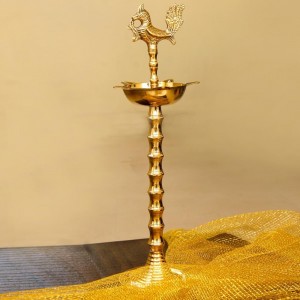 During puja lamps are lighted and usually placed on each side of the main worship area. The purpose is both practical and symbolic. In a time before electrical lights were available, the lamps provided illumination, but today the purpose is mainly symbolic. In some cases five separate flames are lighted on each side of the puja area. Fire is one of the five basic elements of matter (the others being earth, water, air and space and so the five flames represent these five elements of matter.
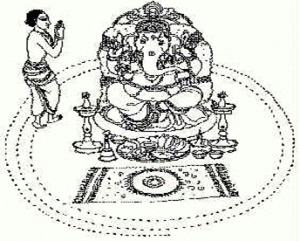 Pradakshina means circumambulation or moving around in a circle. In a temple devotees may perform circumambulation around a Deity or even around the whole temple. One may also circumambulate a sacred object such as a tulasi plant or even a cow. Circumambulation, like touching the feet, is an act of submission, reverence and devotion. The devotee is putting the object of veneration in the center of his or her life. In general circumambulation is always in a clockwise direction. This is in accordance to our much mentioned metaphor: the sun equals light, which equals knowledge, which equals, consciousness, which equals liberation. The source of light, the sun appears to move in a clockwise direction across the sky from east to west and so circumambulation follows the way of light, left to right. Sometime an act of circumambulation is not done by walking, but also by laying on the path fully outright and then getting up, laying out again and moving one body length, and then repeating the process one body length at a time all the way around the object of veneration. It is not uncommon to see this done around temples and even around whole towns such as the holy city of Vrindavan in India. Such an act of circumambulation is over 30 kms in length! In a less extreme form, it is common for devotees to circumambulate a temple by walking around a certain number of times, sometimes as many as 108 times. 108 is a sacred number.
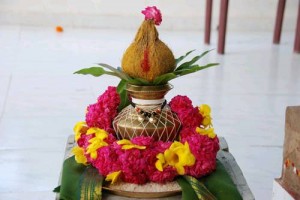 A kalasha is a metal pot of a certain shape usually made of copper or brass. The kalalsha is most commonly used to hold a coconut and leaves during puja. See the illustration. This combination of copper pot, coconut and leaves becomes a symbolic receptacle for the placement of a Deity. The coconut is the head, the leaves are arms and legs, and the pot is the body. The kalasha is also used during bathing ceremonies (see
 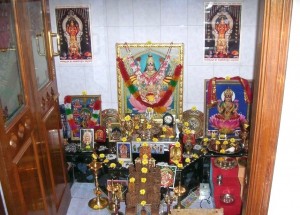 Most Hindu homes will include a prayer room where a small shrine is kept that holds the family Deities and other sacred objects. In the simplest case, this prayer room may be placed in a small closet, cabinet or even shelf. In a more elaborate case, a separate room may be dedicated for the shrine. Ideally this room would be in the northeast area of the home, which is isha-kona (God’s corner) according to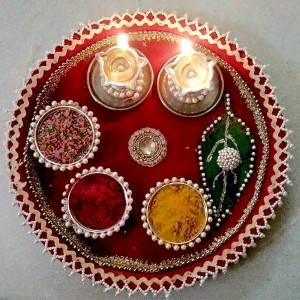

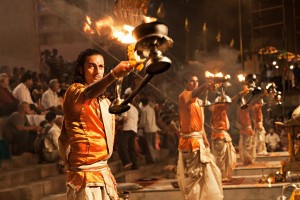 The second reason is purely symbolic and goes back to our metaphor: the sun equals light, which equals knowledge, which equals consciousness, which equals liberation. Think of the flame as a kind of bhoga which then becomes a prasada after being offered to the Deity. The flame is then presented to the worshippers who sweep their hands across the lamp in a gesture that suggests “scooping up” the light and bathing their eyes, face and head with the blessings of knowledge, etc. In an interesting side note, when a ghee wick is prepared usually two wicks are twisted together. The two wicks combined make a larger flame and one that symbolically represents the soul and God (atma and the paramatma), combined.
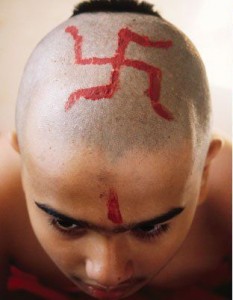 Today, the Swastika is primarily known as a symbol of racism, persecution and anti semitism, which arises from the ideology of the German Nazi party in the 1930s and 40s and World War II. I remember performing a wedding between a Hindu girl and a Jewish boy when at the beginning of the ceremony, where it is traditional to hold a decorative cloth between the boy and girl, the Hindu mother proudly presented a special cloth with a huge red Swastika that she wanted me to hold between the couple. Half the audience was Jewish! On another occasion, I performed a ground-breaking ceremony for a Hindu family, who was going to build a new home in an exclusive gated community. The man had me draw a large red Swastika on the ground where the house was to be built. Later, as we were walking around the perimeter of the property, someone came walking a dog and saw the red Swastika. In terror, this person called the police thinking that a neo-Nazi cult was moving into his neighborhood. On many occasions, I have had to explain to confused fire and building inspectors why there are Swastikas in our Hindu temples. As a priest, I regularly bless people using the expression, svasti svasti svasti! and even inscribe swastikas on the heads of newly shaved children for their health and prosperity!