Sri Deva Sthanam

Where Faith and Scholarship Meet

  • Sri Deva Sthanam
  • About Us
  • Hindu Primer
  • Biography
  • Translations
  • Articles
    • Biographies
    • Sanskrit
    • Astronomy
    • Samskara
    • Vedic Chants
  • Vedic Chants
  • Sanskrit

March 2, 2014 by admin

Fasting: Upavasana

Image of a woman eatingThink of fasting as a “holiday” for the senses, a chance for the body to cool down from the constant bombardment of sensual simulation and a chance for it to slow down and catch its breath. Fasting is a kind of austerity (tapas), and like all austerities involves the voluntary stopping of contact between the senses and their sense objects. This may seem like an unusual way to think of fasting, but the fact is our body is composed of many sense organs (more than just five according to Hinduism) that each has a corresponding sense object. The ear, for example, interacts with sound, the eye with light, the tongue with taste, and even the stomach, which is considered a sense organ, with food, and so on. When contact between the sense organs and their objects occurs there is sensual stimulation which then sends an impulse to the brain which interprets the impulse as pleasure or pain, hot or cold, hard or soft, etc. In this way, our senses are sending a steady stream of sensual data to our brains. By voluntarily avoiding contact between the senses and their sense objects we are stopping, or at least decreasing, the amount of input to our brains. Tapas is the process of limiting sensual stimulation to our brains and giving our brains a period of rest. This is why fasting is a kind of holiday for, not just the senses, the whole digestive system and the total body. In the modern world we are confronted with an unending stream of sensual stimulation coming from all sources and so a certain amount of austerity is a good thing because it allows our over-heated systems to “cool down” and rest. It recommend that when one fasts one should take a real holiday away from the world and not try to go on with life as usual. Take the day off and rest if you are going to fast. Try not speaking for the day as well. The effects of not speaking will really astound you!

There are all varieties of fasting. Some fasting avoids all foods and even water. Then there is water only fasting or juice only fasting. Some fasting is partial, which could mean no heavy foods like meat, beans or grains. Then there are half day fasts or fasting that just avoids salt. If you understand the concept of fasting as described above you can decide what degree of fasting suits your situation. Hindu scripture suggest certain days of the week, month or even year for fasting. In particular many Hindus fast twice a month on the ekadashi, the 11th day of the waning and waxing moon. The Nava Ratris are also a good time for fasting. Some people fast every Monday. There is no end to the variation, but in general it is good to take a holiday every once in a while.
Filed Under: Philosophy

March 2, 2014 by admin

Yoga and the Yogi

Today one hears of yoga everywhere. People go to yoga classes for exercise and weight reduction; people do yoga meditation to reduce stress and to help sleep at night; one even hears of a yoga diet. In his classical treatise on yoga, Patanjali, an ancient yoga master, defines yoga as, “stilling the movements of the mind” (citta-vritti-nirodha). So what does exercise, weight loss, diet, relaxation and improved sleep have to do with “stilling the movements the mind”? Indeed, there is a lot of confusion regarding what is actually meant by yoga.

The word yoga comes from the Sanskrit root yuj, meaning “to join.” The English word “yoke,” as in, “to yoke a team of bulls,” is also derived from this same Sanskrit root. The word yoga is used throughout the Bhagavad Gita in the sense of “joining,” or integrating oneself with ultimate reality, call this “joining the soul with God” if you wish. So the question arises, what are the means of joining? These “means” are the different paths or forms of yoga. Throughout Hindu literature there are dozens of different forms of yoga often described as raja yoga, hatha yoga, ashtanga yoga, sankhya yoga, pranayama yoga and even japa yoga, but reduce it all down, and there are four basic forms of yoga that become the building blocks for all these other forms of yoga. These four basic forms of yoga are karma, bhakti, jnana and dhyana yogas. A person who practices one or any combination of these yogas is a yogi. Let us explain each of these four basic yogas.

Karma Yoga

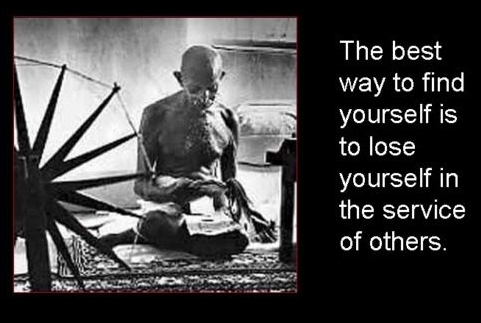
Image of Gandhi SpinningIn Sanskrit the word karma simply means action. What a person does, both involuntarily and voluntarily, is karma: breathing is karma, the heart beating is karma, eating in karma, working is karma, and so on. In other words, ordinary action is karma. Karma yoga, however, is a different kind of action. It is action that brings one closer to a spiritual reality. It is spiritual action. If you recall the meaning “joining” for yoga, then literally any action that joins one to a spiritual purpose is karma yoga. In practice, however, karma yoga usually refers to working with a spiritual purpose. It is not necessarily a different kind of action, but an action performed with a different kind of attitude: seeing one’s self connected to a higher, or spiritual, purpose is karma yoga. For example, one may act as a policeman, upholding the laws of the state. This is ordinary karma, but if one adds a spiritual dimension, viewing oneself as working for God, for example, or perhaps donating a percentage of one’s wages to a spiritual purpose, such action ceases to be ordinary karma and becomes karma yoga, and a person who acts in this way is a Karma Yogi. As far as most people are concerned, the vast majority of us live as working members of society, and so the most common form of yoga is karma yoga, ordinary people performing so called ordinary works, but with a spiritual vision. There are a lot of striving karma yogis in this world and they get little recognition. Yet a yogi, including a karma yogi, in the estimation of the Bhagavad Gita, is a most exalted person.

Bhakti Yoga

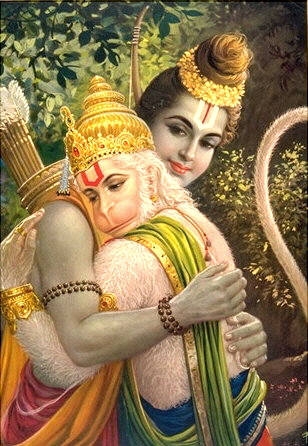
Image of Rama and HanumanThe word “bhakti” means love, and devotion. Bhakti yoga is the cultivation of love and devotion. A devotee who brings fruits and flowers, and who bowes and prays before a sacred image of Krishna, for example, is practicing bhakti yoga. A Christian who dedicates one’s self to Christ and tries to cultivate love towards Jesus is also performing bhakti yoga, devotional joining. In fact, most of the devotional actions performed in temples, churches, synagogues and mosques fall under the category of bhakti yoga. Most what one usually thinks of as being religious falls under the purview of bhakti yoga. A pious Hindu, Christian, or Muslim is a bhakti yogi.

Jnana Yoga

In Sanskrit the word “jnana,” written and pronounced as gnan in most north Indian languages, means knowledge. Ordinary, so called secular knowledge, is jnana, but jnana yoga is the cultivation of knowledge with a spiritual purpose. This is generally thought to be scriptural knowledge. For example, learning Sanskrit and studying the Upanishads and other Vedic literatures would be jnana yoga. Applied to the Jewish tradition, to give some breath to the idea, the study of the Torah or Mishnah would also be jnana yoga. But jnana yoga can also include more than just scriptural knowledge. The study of the cosmos, mankind’s attempt to reach into outer space with space telescopes or robotic satellites, if done with a spiritual perspective, could also be an act of jnana yoga. A scientist who uses an electron microscope and peers down into the detailed complexity of life and who feels a sense of awe and reverence for the miracle of life and the details of physical reality, and who can sense a spiritual foundation laying behind the mystery of life, is similarly practicing jnana yoga. It all depends on attitude. Such persons are jnana yogis.

Dhyana Yoga

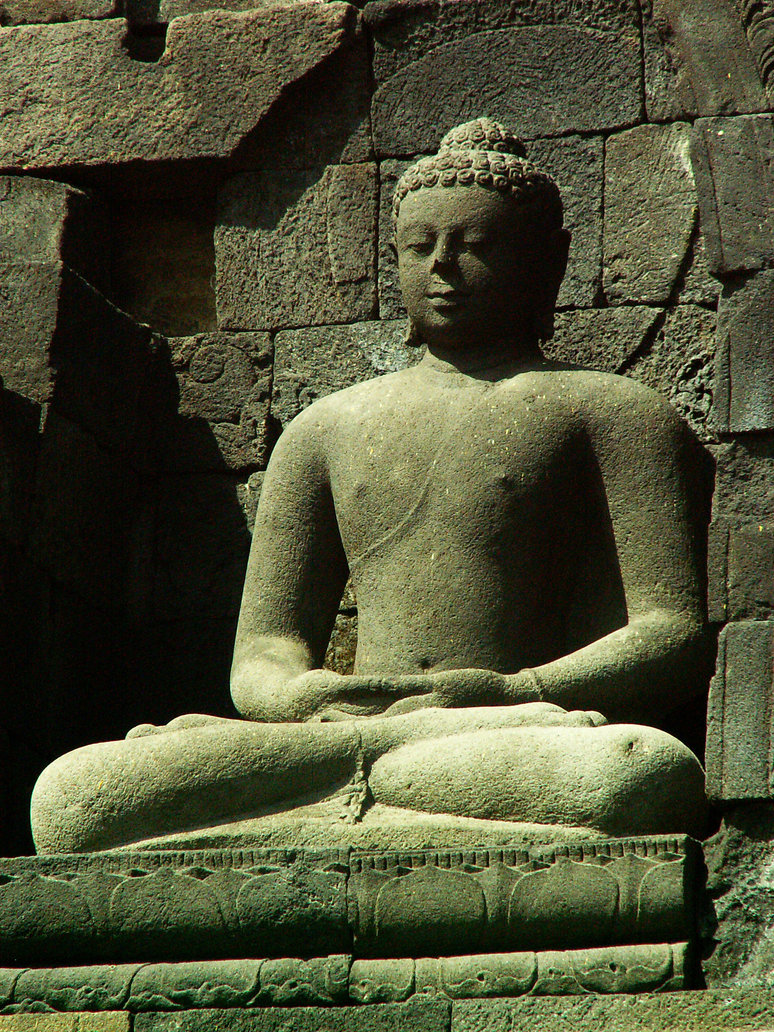
Image of Buddha in MeditationThe word dhyana means meditation; it is derived from the Sanskrit root dhyai, “to think of.” Dhyana yoga is the meditation and contemplation of things spiritual. This, of course, is typified by the classical image of the meditating yogi, and in many ways, this is how most people think of yoga in general. A yogi with a large beard completes such the image! There is a popular form of dhyana yoga called kundalini yoga that many people in the West know as yoga. In fact Patanjali’s Yoga Sutras, wherein he defines yoga as, “the stilling of the movements of the mind,” falls under the category of dhyana yoga. Stopping the movements of the mind is the key to meditation. The yoga exercise classes that people attend in the modern world for weight control or stress reduction are also a part of the dhyana yoga process, which  is called hatha yoga. In order to achieve the meditative state, the body and mind need to be strong, healthy and controllable. The means to achieve this end is hatha yoga. Breath control is also conducive to mental control and meditation, and is similarly part of dhyana yoga. Breath control is often called pranayama yoga. The so called raja yoga, the royal yoga, is just a particular combination or “packaging” of hatha yoga, pranayama yoga, kundalini yoga, jnana yoga and dhyana yoga. Even the ashtanga yoga that I mentioned eariler is just another form of yoga packaging. Ashta means eight and anga means parts, so ashtanga yoga is an eight step process of yoga that is grounded in dhyana yoga. I even saw an advertisement for Vikrama Yoga recently. Vikrama means strength and courage. I let the reader consider what kind of yoga mix this might be, but you can be certain it is just another packaging of yoga.

Filed Under: Philosophy

March 2, 2014 by admin

What is Dharma?

Image of Police Car
To Serve and Protect

Dharma is one of the most important themes within Hinduism. One often sees dharma translated as religion, duty, or even righteousness, but in fact, there is no single direct translation for dharma. Religion, duty and righteousness are not wrong; they are simply included within the idea of dharma. The word “dharma” comes from the Sanskrit root dhri, meaning to “uphold” or to “sustain.” From this perspective, the best way to think of dharma is to say, “that which upholds or sustains the positive order of things: the nation, the community, the family and ultimately even the universe.” At a social level, every individual has a particular dharma according to their place in life. Children have a dharma, parents have a dharma, teachers have a dharma, the police have a dharma and even the head of a nation has a dharma. One of the dharmas of a child, for example, is to obey parents and to study. Parents have a dharma to protect and look after children: to make sure they are educated, fed, housed and trained. It is sometimes written on the sides of police cars: To Protect and Serve. This is a statement of dharma for police. A head of state has a dharma to protect the country and to provide a secure environment for its citizens. If everyone performs their dharma: children obey parents, parents look after children, citizens uphold the laws of the land, the police enforce the law, a head of state protects the nation, then the family, the community and the nation are “upheld” and there can be prosperity. This is dharma, and it all follows from the idea of dhri, to uphold.

Graffiti as Adharma
Graffiti as Adharma

The opposite of dharma is “a-dharma.” What this means is obvious. If children fail to obey parents, if parents do not train and discipline children, if the police misuse their power and fail to protect, if the head of state fails to act in the interest of the nation, then adharma exists, and when there is too much adharma, there will be a break down of the family, society or the nation. The nation, the community, the family and even individuals cannot prosper when too much adharma reigns. There is a saying, dharmo rakshati rakshitah “Protect dharma and dharma will protect you.”


Individuals have different dharmas at different times in their lives. A child has a certain dharma that we mentioned above, but the same person as an adult has different dharmas to focus upon. And still later in life, there are other dharmas that need to be stressed. When one is married, one should not live according to the dharma of a child. If an adult adopts the dharma of a child this is adharma. A child cannot follow the dharma of the police. If an ordinary citizen tries to follow the dharma of the a head of state it results in adharma.

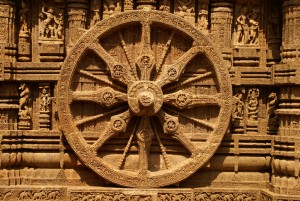
Image of Wheel of Dharma from Konark
Konark Wheel of Dharma

The ancient Hindu social system was called Varnashrama Dharma and the great epics of India, the Ramayana and the Mahabharata are built on this system of dharma. In the Ramayana, the hero Rama exhibits the ideal execution of the dharma as a son and king. Sita, his wife, illustrates the dharma of the ideal woman and wife. Hanuman, the divine monkey, exhibits the dharma of a devoted servant in the way he serves Rama. The evil Ravana, the villain, is the very personification of adharma as he kidnaps Sita and tries to usurp Rama’s kingdom. In the end adharma destroys Ravana. In the Mahabharata, a great war takes place as dharma and adharma collide in a cosmic struggle over good and evil. In the end, good triumphs over evil. Dharma always rules over adharma. This is the way of the universe.

The word dharma is also used in a different way within Hindu philosophy that can also be understood from the root dhri. Every constituent of matter: liquids, metals, gases, fire, and so on have different dharmas. For example, the dharma of water is liquidity and wetness. The dharma of ice is solidity and coldness. The dharma of fire is heat and light. In other words, whatever it is that makes water, water or ice, ice, or fire, fire; what “upholds” the state of being water-ness, ice-ness, or fire-ness, etc., is dharma. These ideas occupies an important part of Hindu philosophy and even though they are subtle, I think the reader can see how even this use of dharma comes from the root dhri Indeed, the idea of dharma is paramount within both Hindu religion and philosophy.

Filed Under: Philosophy

March 2, 2014 by admin

Spiritual Qualification and Ownership: Adhikara

Image of Advanced Chemistry
Chemistry and Adhikara

There is an important Sanskrit term that will help us better understand Hinduism, or any other religion. It is adhikara, which means “authority” and “ownership.” A person in an advanced chemistry class, for example, who has taken previous chemistry courses has the adhikara to be in the advanced class. That person is qualified to be in the advanced class. Someone who has not taken chemistry before has no adhikara to be in a graduate class. We could translate adhikara as “qualification,” which is implied, but more than qualification, the term suggests ownership. This means, in the case of chemistry for example, that the person at the advanced level has the right to interpret, apply and teach chemistry. That person is an “owner” of that body of knowledge and consequently has a right to that knowledge. A person in an elementary class of chemistry has no adhikara for the body of advanced chemical knowledge. Such a person has no right to teach and apply the knowledge of chemistry. The kinds of information and experiments a beginner receives will therefore be different from the information and experiments of the advanced graduate. Their adhikaras are different and therefore their activities and rights are different. This is what is meant by the word adhikara.

Image suggesting Spiritual Evolution
Spiritual Evolution

From a Hindu perspective, life is a great evolution taking place over many lifetimes, even through many species of life! We can say the world is a school and each lifetime is a classroom. Some of us are in elementary grades, others are in middle grades, and some are in advanced grades. And like students of chemistry, every person has a particular adhikara over a certain level of spiritual development. Students in elementary grades see the world in a certain way and must be taught in a certain way. Students at an advanced level need to be approached in an appropriate way to suit their positions. The different adhikaras have different perceptions and spiritual rights. The idea of adhikara and spiritual evolution becomes a powerful tool in understanding spirituality, especially for religious teachers and priests. A temple priest in particular must deal with all varieties of adhikara, from the most advanced to the most elementary, and so having an understanding of adhikara will greatly help the priest minister to the needs of the congregation.

Here is a simple example. There is a common puja that temple priests perform called the Satya Narayana Puja, which includes a story (katha) that is read after the completion of certain religious rituals. In essence the story teaches that if one is pious and religious the devotee will be rewarded with material rewards in this life and then will achieve moksha at the end of life. And if one is not pious that person will loose everything in this world and go to hellish situation. I am simplifying things somewhat, but that is the gist of the story. I recently performed this puja and afterwards was approached by a Western born Hindu girl of about 16 years of age. She was upset and confused why God would be so vindictive and cruel. To her, the story seemed juvenile and God seemed out of character. To answer her concerns, I explained that all religions have stories that teach reward and punishment for pious or impious actions. I call this carrot and stick philosophy and I explained how a parent might promise a reward for good grades at school or threaten punishment for poor grades. “But this is how parents may treat a 6 or 7 year old child!” she replied. “Yes, exactly,” I stated. “So the story of Satya Narayana is for children?” I would not say children, but for people of a certain stage of spiritual advancement. I explained the concept of adhikara and how there are different stories and religious approaches for the various levels of religious adhikaras. In fact this young girl was not the intended audience for the Satya Narayana puja and so she was reacting to the story from a different level of adhikara. Therefore, knowing the adhikara of your audience is an essence piece of information.

Filed Under: Philosophy

  • « Previous Page
  • 1
  • 2
  • 3
  • About Us
  • Hindu Primer
  • Biography
  • Translations
  • Articles
  • Vedic Chants
  • Sanskrit

Copyright © 2024 — Sanskrit Religions Institute • All rights reserved. • Privacy Policy • Disclaimer