Sri Deva Sthanam

Where Faith and Scholarship Meet

  • Sri Deva Sthanam
  • About Us
  • Hindu Primer
  • Biography
  • Translations
  • Articles
    • Biographies
    • Sanskrit
    • Astronomy
    • Samskara
    • Vedic Chants
  • Vedic Chants
  • Sanskrit

March 2, 2014 by admin

A Sacred Plant: Tulasi

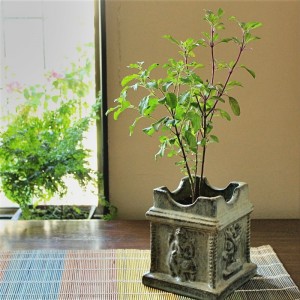
Typical Tulasi Container

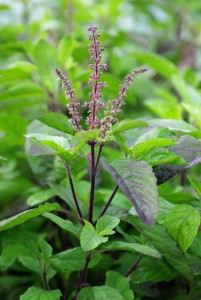
The tulasi plant is a small perennial shrub in the mint family that is native to India and which is venerated by Hindus in general and Vaishnavas in particular. The botanical name is ocimum tenuiflorum or sometimes, ocimum sanctum, the sacred Basil. In Hindi and other north Indian languages the name is written just a tulsi.
Tulsi_KRSNA_purple_350
Krishna or Syama (dark) Tulasi

There are three varieties of tulasi plants used by Hindus. There is a dark variety called syama or krishna tulasi, a white variety called rama tulasi, and an extremely hardy variety sometimes called Fujian or Thai tulasi. Many orthodox Vaishnavas do not accept this latter tulasi as true tulasi although this variety is the most common of all since it is easiest to grow. This Thai tulasi is distinguished from the two former varieties because it is much larger. The syama or krishna tulasi is the smallest variety and is the most difficult to grow.

No Hindu home is considered complete without a tulasi plant. Mostly, the tulasi is grown directly in the ground, but sometimes it is grown in a special container that allows places for lamps. See the illustration to the left. Vaishnavas worship tulasi as the Goddess Lakshmi, the consort of Vishnu and so during puja, tulasi leaves are offered to the feet of Vishnu. Lakshmi is the wife of Vishnu and so the offering of tulasi leaves is the offering of love. Tulasi leaves are also dipped in sandal paste and stuck to the feet of Vishnu during puja.
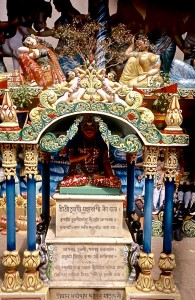
TulasiMandirVaishnavas carve the wood of the tulasi plant and use it for chanting beads (japa mala). It is also common to see small tulasi beads worn in strands around the neck. During the month of Kartika (October-November) a ceremony called tulasi vivaha is commonly celebrated, This is a wedding ceremony where tulusi is “married” to Vishnu or Krishna. Sometimes Vishnu comes in the form of a sacred stone (shalagram shila), so it is interesting to see a marriage between a plant and a stone! You can imagine how strange this seemed to the British when they saw such a ritual in temples without a clear explanation of what was going on. The tulasi plant is fully decorated with a wedding sari, jewelry, and sometimes even a face made of silver or hardened wheat dough. It is a fun ceremony to watch as the “parents” of both the bride and groom proudly carry their son and daughter through the paces of the marriage ceremony.

The tulasi plant also has many medicinal properties. Extracts from tulasis are used in traditional Ayurvedic medicines for common colds, headaches, stomach problems and even heart problems. Preparations of tulasi are often made into a tea or a powder or even just eaten as fresh leaves along with ghee, clarified butter.
Filed Under: Sacred Objects

March 2, 2014 by admin

Divine Blessings: Prasada

Bhoga Offering
A Bhoga Offering

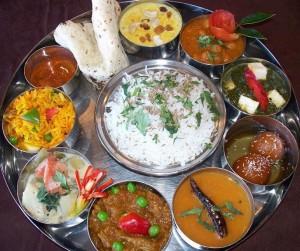
The word prasada means “mercy” or “blessings.” Therefore something coming back to the worshipper after being offered to a Deity is the mercy or blessings of that Deity. The counterpart of prasada is bhoga, which are the items being offered to the Deity. You might think, bhoga in prasada out. The word bhoga literally means “enjoyment.” Therefore anything enjoyable is a bhoga. So in effect, when we offer bhoga to a Deity we are offering enjoyment, nice things, to the Deity and we receive prasada, blessings in return. Many people think bhoga and prasada are food items alone. This is not true. Anything offered to the Deity and returned to the worshiper is bhoga and prasada, which includes flowers, incense, a flame and even shringar, Deity outfits. In ordinary language, food is called bhoga because it is enjoyable! The scent of the offered incense or flowers is a prasada. The light of the lamps that is “touched” by the hands and then “bathed” over the eyes and head is a prasada. The sound of the devotional prayers are a prasada and, of course, the offered food coming back is a prasada. Indeed, the whole point of a puja, archana, yajna or havan is the creation of prasada, blessings to the devotees. Puja, therefore, is an exchange of love between the devotee and the Deity. The devotee offers various bhogas to the Deity, which, in effect, convey the love of the devotee to the Deity, and the Deity reciprocates by sending His or Her love back to the devotee in the form of blessings, prasada.

Filed Under: Sacred Objects

March 2, 2014 by admin

Why do Hindus wear marks on the forehead?

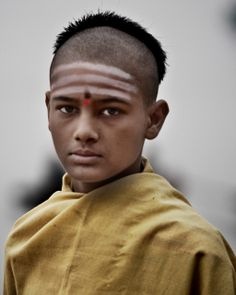
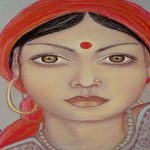
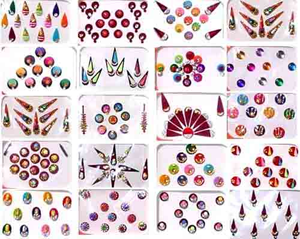
bindiIn Sanskrit the name for the marks worn on the forehead is tilaka, which literally means, “ornament.” In Hindi the word is shortened to tika. There are three basic uses for the tilaka marks: The mark worn by ladies as part of their makeup; the red “dot” that is applied during puja; and the mark worn by priests and other religious people. In a form of yoga called kundalini-yoga certain places on the body are known as chakras or places of “psychic openings.” The most important of these places is the space between the eyes just above the eyebrows. This is sometimes called the place of the third eye, and this is the main place where the tilaka is worn.
bind1
A variety of stick-on Bindis

Ladies will commonly mark their forehead with a makeup mark called a bindi. This bindi is usually “stick-on” and comes in all different shapes and colors to match dress and makeup.

Similarly, during puja a priest will commonly apply a dot of red powder called kukuma at this same location to both man and ladies. Sometimes this form of puja tilaka mark is explained: God has given us two eyes by which we see the physical world, now this tilaka is a symbolic third eye by which we can see spiritual reality.

Shaiva Tilaka
Shaiva Tilaka

The tilaka marks worn by priests and other religious people has a completely different purpose. Essentially the lines of tilaka are sectarian marks that indicate which school of Hindu theology (sampradaya) the person is coming from. So these kinds of tikala are identification marks. There are three categories indicating the three basic grouping within Hunduism. Horizontal lines for followers of Shiva, vertical lines for followers of Vishnu and straight on marks for followers of Devi. Within each of these categories of devotees there are many variations, black lines, red lines, yellow lines, curved lines, rounded lines, and so on. Each of these configurations indicate the particular school of theology within each group, and there are many many designation even within a single group.

Filed Under: Sacred Objects

March 2, 2014 by admin

Namaste and Bowing as Signs of Respect

Namaste
Namaste

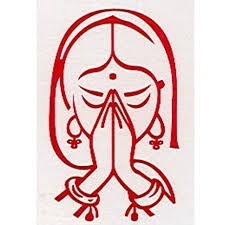
“Namaste” is made of two words, namas and te. Namas comes from the verbal root nam which means to bow and so namas is a bow or salutation. Te means, to you. And so namaste literally means, bowing to you. There is a variation of this in the form namaskara. The Sanskrit word “kara” means, doing. So namaskara literally means, doing salutations. Many Hindus say that when they do namaste they are bowing to the soul (atma) and God (paramatma) within and not to the body without. By contrast shaking hands is a gesture of respect to the body, whereas in Hinduism bowing to the soul within is considered more important. Hence, namaste is made with two hands held together at the heart where the soul is said to reside.

Why do we bow before parents and elders?

Respect to Elders
Respect to Elders

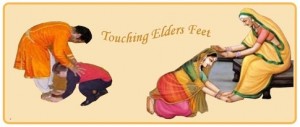
Bowing to parents, elders, or for that matter, all seniors including teachers and saintly people, is an important matter within Hinduism. Children are taught to bow to elders from an early age. Bowing is a sign of submission and a way to show respect. In addition, the act suggests the hierarchical nature of Hindu society where juniors submit to seniors. But there is still more involved. Bowing is not just bowing one’s head. To bow generally means touching the feet of seniors, and feet hold a powerful symbolism within Hindu culture. From a child’s perspective, parents, teachers and elders are considered “gods” therefore bowing to the feet of seniors is the way showing the highest respect.

Filed Under: Sacred Objects

  • « Previous Page
  • 1
  • …
  • 4
  • 5
  • 6
  • 7
  • 8
  • …
  • 33
  • Next Page »
  • About Us
  • Hindu Primer
  • Biography
  • Translations
  • Articles
  • Vedic Chants
  • Sanskrit

Copyright © 2024 — Sanskrit Religions Institute • All rights reserved. • Privacy Policy • Disclaimer