Sacred Designs: the Yantra
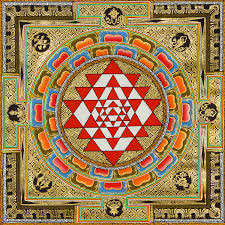
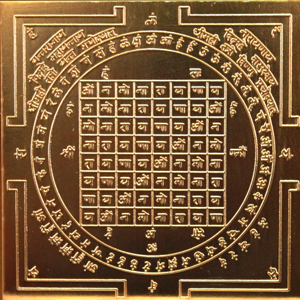
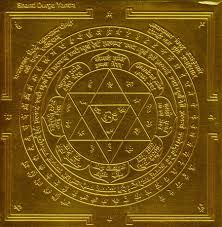
The general meaning of the word yantra is “a machine,” or an “apparatus” and so in this sense a washing machine, a television or even a computer is a yantra. In a religious context a yantra is a symbolic diagram that represents a Deity and is used primarily for puja and meditation. Yantras are generally inscribed onto thin copper or silver plate that shows a geometric shape, often with some numbers or even the inscription of a Deity. Virtually every Deity will have a yantra. Thus it is common to find Narayana yantras, Lakshmi or Shri yantras, Nava Graha yantras, Durga yantras, and so on. A yantra is used in much the same way as a murti or sacred image is worshipped during puja. Yantras have other uses as well. They are often placed underneath a sacred image when it is newly installed into a temple altar.
A Shri yantras, (the yantra for the Goddess of wealth and prosperity) or a Ganesha yantra (for good luck) is often kept near one’s check book or business books. Yantras are often used in astrology. If one needed to boost the influence of a certain astrological influence, the yantra for that planetary influence may be worshipped and kept on a family or personal altar. Yantras are sometimes placed above doorways or near entrance ways to homes and other buildings. See the illustrations of some typical yantras.

The Shathari: God’s Feet
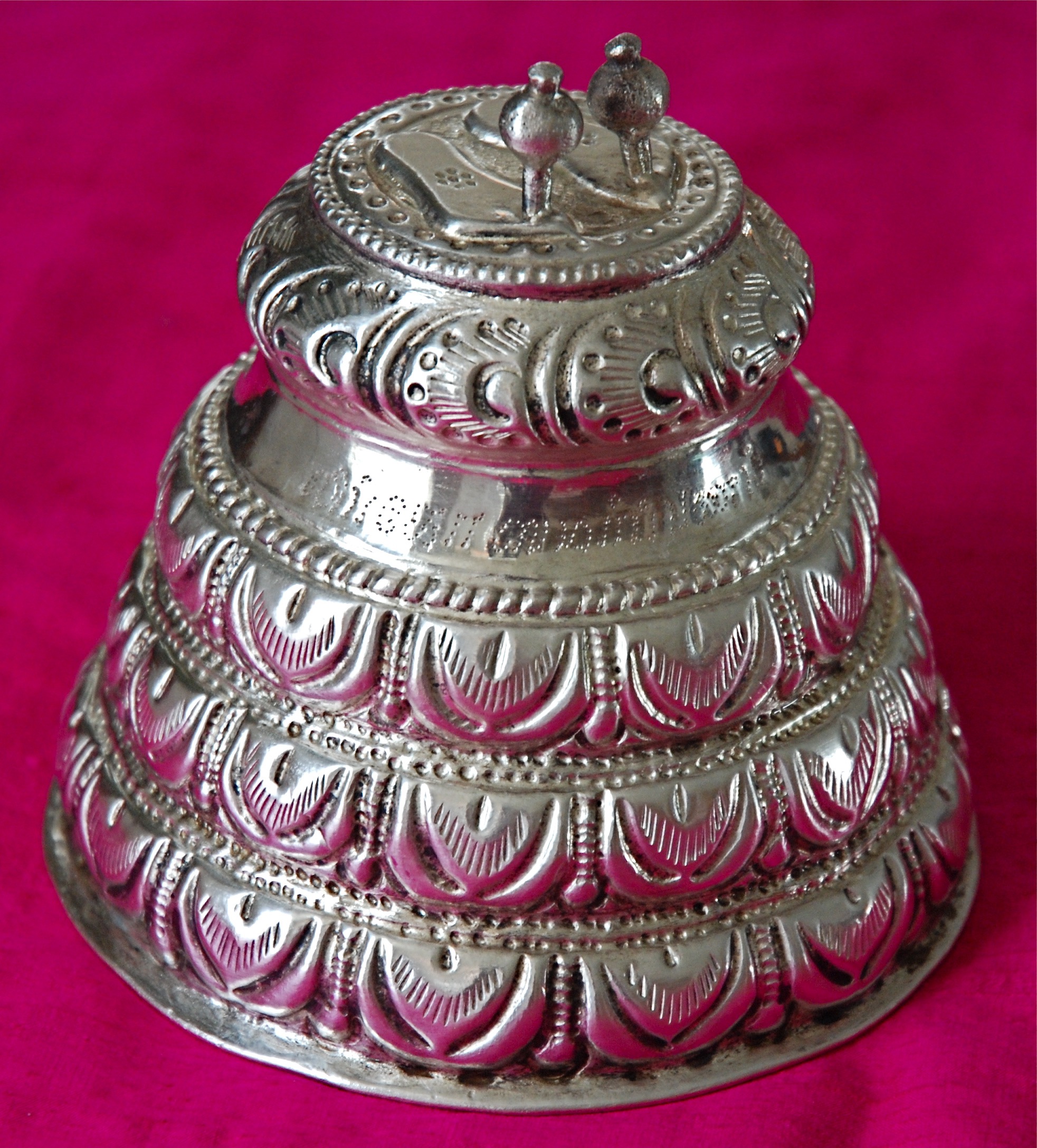
The shathari is an altar implement used primarily in many South Indian style temples. There is a famous temple in South India, just north of Chennai (Madras), that is dedicated to a particular form of Vishnu known as Shri Venkateshwara or Balaji for short. Modeled after this original Balaji temple, many cities in the West now have a Balaji Temple. Ordinarily most Hindus never see the shathari unless they visit this original Balaji temple in South India, but now that Balaji temples have proliferated around the world, the shathari is commonly seen.
At first look most people think that the shathari is some kind of a silver helmet that priests touch to the head of devotees, but in fact the helmet is a stand (pitha) for a small pair of shoes that are permanently mounted to the top. See the illustration above. The shoes are a symbol for the feet of God and so to be touched by the shathari is to have the feet of God placed on one’s head. This is a blessing.
The word shathari is made of two smaller words, “shatha” and “ari.” Shatha means “corruption,” “deceit” and “ego;” ari means “enemy.” So the shathari is literally the “enemy of deceit or ego,” which means that the feet of God are the enemy of bad things. In other words, the blessing of God destroys all bad things in the heart of the devotee. Ordinarily devotees will come for the divine seeing (darshana) of Balaji and in turn the priest will touch the shathari to the head of the devotee as a blessing.
Hindu Education: Guru Kula and Bal Vihar
The ancient system of Hindu education was called Guru Kula, which literally means “the family or home of the teacher.” In the days before government mandated schools in India, children would attend the home of a local brahmana teacher for education. In the tradition social system called Varnashrama Dharma the brahmanas would play the role of teachers and the children of the other classes would go to these brahmanas for schooling. Sometimes these schools would be associated with a local temple or ashrama and the the curriculum would involved a mixture of religious and practical education. Today the system of Guru Kula has been replaced by modern schools systems and the only Guru Kulas that still exist function as private religious schools connected to a religious organization.
Today Hindu religious education is mainly provided in small groups called Bal Vihars. A Bal Vihar is the Hindu equivalent of a Christian Sunday School. In other words, it is religious education provided by a Hindu Temple or some other organization or even by a group of parents on a weekly, bi-weekly or monthly basis. Sometimes other names are employed such as Bal Vikas instead of Bal Vihar for the same thing.
- « Previous Page
- 1
- 2
- 3
- 4
- 5
- 6
- …
- 33
- Next Page »